
Head of East Asia Regional Delegation for IFRC Olga Dzhumaeva Visits the ICC
Following their working agreement, Olga Dzhumaeva, Head of the East Asia Regional Delegation of the International Federation of Red Cross and Red Crescent Societies (IFRC), led a delegation to visit the Jianguomen Office of the International Cooperation Center (ICC) on 2 March 2026. Zhang Zhixiang, Member of the Strategic Advisory Committee of the ICC, Chairman of the International Monetary Research Committee and Senior Expert on International Organizations and Multilateral Cooperation, together with Zhang Yu, Convener of the Joint Meeting and Director of the Steering Committee of the ICC, met with Olga Dzhumaeva. The two sides held talks on forward-looking research on the international crisis landscape, coordination and cooperation in global humanitarian action, and the organization of high-level policy dialogues and thematic conferences. Both sides agreed that the global humanitarian situation is facing unprecedented challenges. The ICC and the IFRC should strengthen coordination and collaboration to address humanitarian crises and inject positive energy and stability into a turbulent world.
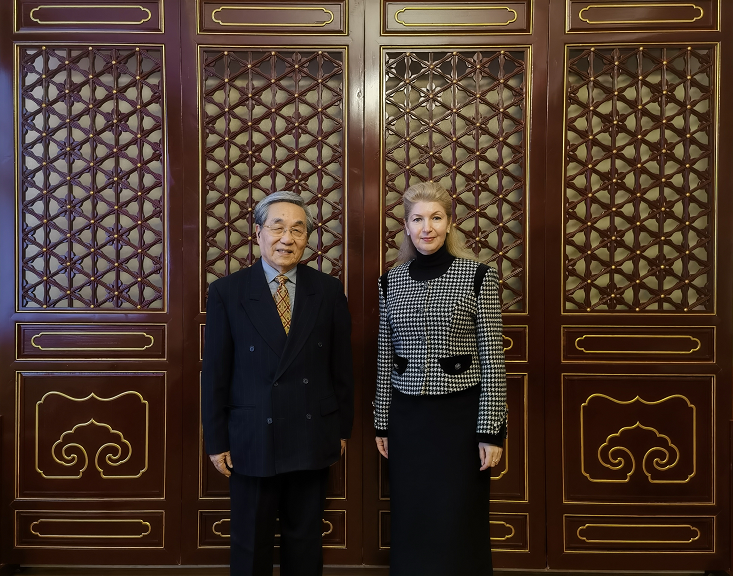
Zhang Zhixiang (Left) Olga Dzhumaeva (Right)
They noted that the world is undergoing a new period of turbulence and transformation, with profound shifts in the international balance of power, profound adjustments to political and economic order, frequent natural disasters, and a complex and grave global humanitarian landscape. Humanitarian causes are a common endeavor of humanity and an important part of building a community with a shared future for mankind. The ICC is a comprehensive international strategic research institute and a key platform for China’s external exchanges and international cooperation, with strengths in forward-looking research and crisis response. Founded in 1919, the IFRC is the world’s largest humanitarian network, comprising 191 National Red Cross and Red Crescent Societies. Their long-term cooperation is of great significance. The two sides unanimously agreed to establish a close strategic partnership between the ICC and the IFRC East Asia Regional Delegation, and to continuously deepen exchanges and cooperation, contributing to the development of the international Red Cross and Red Crescent Movement and the building of a community with a shared future for mankind.

The two sides held a meeting
Other important matters were also discussed. Prior to the meeting, Olga Dzhumaeva visited the exhibition hall of the ICC. The two sides reviewed the history of relations and cooperation between China and the International Red Cross and Red Crescent Movement. The ICC briefed to the IFRC delegation on its recent coordination and cooperation with the United Nations and other international humanitarian organizations, while Olga Dzhumaeva updated the center on the current global humanitarian situation.
Cheng Yu, Executive Secretary General of the ICC; Zhang Bin, Deputy Director of the Hong Kong, Macao, Taiwan and Overseas Chinese Working Committee at the ICC; Wu Zhonglin, Executive Director of the Development Committee at the ICC; Xin Shaosong, Executive Deputy Director of the ICC’s Secretariat Office; as well as Lin Jialei, Deputy Head of East Asia Regional Delegation for IFRC, and Liu Mengze, Senior Partnerships Officer of the East Asia Regional Delegation for IFRC, attended the meeting.
Related Link:
The International Federation of Red Cross and Red Crescent Societies (IFRC) is a global voluntary relief organization founded in 1919. Headquartered in Geneva, Switzerland, it currently has Kate Forbes as its President and Jagan Chapagain as Secretary General. Originally established as the League of Red Cross Societies, the IFRC was awarded the Nobel Peace Prize in 1963 together with the International Committee of the Red Cross (ICRC). It adopted its current name, the International Federation of Red Cross and Red Crescent Societies, in 1991. As the umbrella organization for national Red Cross and Red Crescent societies, the IFRC now has 191 member societies worldwide. It coordinates disaster response, health care, and humanitarian activities across the globe. Its special legal status is recognized by national legislation, and it often collaborates with governments and armed forces during armed conflicts.
In 1999, the IFRC opened its East Asia Regional Office in Beijing, covering five countries: China, Japan, the Democratic People’s Republic of Korea, the Republic of Korea, and Mongolia. The IFRC General Assembly is its highest governing body. It sets overall policies guiding the IFRC and its member societies, decides on the admission or suspension of national societies, and elects the President and Vice-Presidents. Today, the IFRC has approximately 20 million volunteers, more than 190,000 local branches, and nearly 501,000 staff members. Its Secretariat and regional offices employ over 3,000 personnel. The IFRC’s funding comes mainly from statutory contributions from member national societies, as well as voluntary donations from governments, national societies, multilateral organizations, and corporate partners. The People’s Republic of China resumed its legitimate seat in the IFRC in 1952. In 2022, the Chinese Red Cross was awarded the Henry Davison Medal, the highest honor of the IFRC.
 国际合作中心版权所有 © 京ICP备2022021348号-2
©2006 - 2026 Copyright International Cooperation Center
网站版权登记号:国作登字-2022-F-10176092
E-mail:info@icc.org.cn