
Manifestations, Drivers and Implications of the New Round of Restructuring in the Middle East Landscape
Abstract
Since the outbreak of the "Arab Spring", the Middle East landscape has evolved through three phases: a period of conflict and turmoil, an era of intense rivalry between major powers within and outside the region, and a phase of upheaval and transformation. It currently exhibits salient features including the coexistence of regional conflict, rapprochement and development; the interplay of intense competition among external major powers and growing strategic autonomy of regional states; accelerated fragmentation of regional blocs and realignment of old and new alliances; and stronger interaction between regional dynamics and global structural shifts. This new round of restructuring in the Middle East is both an outcome of the decade-long continuous evolution of the Arab upheavals and the superimposition of longstanding and emerging contradictions in the Middle East, as well as a reflection of the global paradigm shift playing out in the region, embodying the new changes in the balance of power between regional and external major powers. Transformations in the Middle East landscape bear profound implications for regional peace and development and the shaping of a new regional order, while forging close interactions with the global order transition, international security and the restructuring of global industrial and supply chains.
In recent years, the Middle East has witnessed rapid and drastic changes marked by frequent "black swan" events. A constellation of new factors—including a regional "rapprochement wave", the outbreak of a new round of the Palestine-Israel conflict and its spillover effects, the Syrian upheaval, accelerated economic transformation and reform in the Gulf, shifts in U.S. Middle East policy, intensified major-power competition and the rise of the Global South—has propelled profound and continuous evolution of the regional landscape, introducing new uncertainties to regional development and stability.
Key Features of the New Round of Restructuring in the Middle East Landscape
Following the end of the Cold War, the Middle East landscape shifted from a bipolar to a unipolar structure. With the conclusion of the post-Cold War era and the waning of Western hegemony, the regional landscape has entered a new phase of restructuring. The current Middle East order has gradually taken shape against the backdrop of severe regional upheavals over the past decade or more. Since the outbreak of the "Arab Spring" in late 2010, the Middle East landscape has evolved roughly through three distinct phases.
Phase One: Period of Conflict and Turmoil (2010–2014). During this period, the Middle East bore the dual shocks of U.S. strategic retrenchment from the region and the disruptive impact of the "Arab Spring" on the regional order. Landmark events included regime changes in Egypt, Tunisia, Yemen and Libya; the outbreak of armed conflicts in Libya, Yemen and Syria; and the rampage of the extremist organization Islamic State (ISIS) across the Middle East. Concurrently, the Obama administration resolved to end U.S. wars in the Middle East and concluded the Joint Comprehensive Plan of Action (JCPOA) with Iran on the nuclear issue, marking the advent of a "post-American era" in the Middle East.
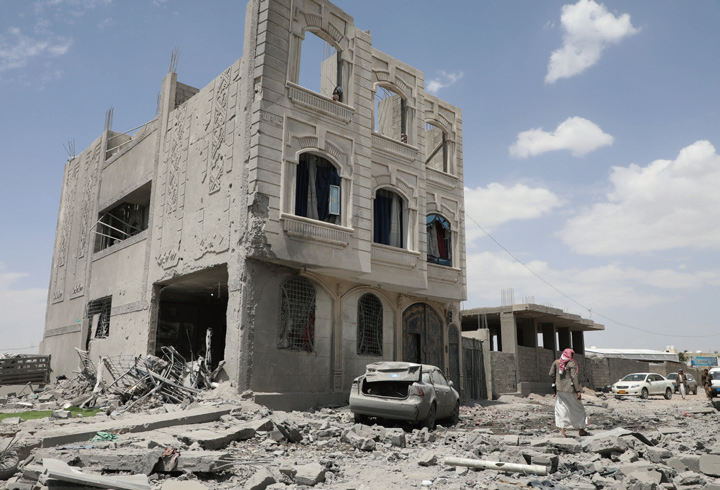
On April 27, 2025, Sana'a, Yemen, the buildings suffered severe damage after a US military air strike.
Phase Two: Period of Intense Rivalry Between Major Powers Inside and Outside the Region (2015–2020). During this phase, the regional landscape was characterized by a U.S. retreat and Russian advance, an East rise and West decline, and a scramble for influence among regional powers. Key landmark events included Russia’s return to the Middle East through its military intervention in Syria, the joint military deployment by Saudi Arabia and the United Arab Emirates into Yemen, and fierce rivalry among three major blocs: the Turkey-Qatar bloc, the Saudi-Emirati-Egyptian bloc, and the Axis of Resistance led by Iran (hereinafter referred to as the Axis of Resistance). Regional proxy conflicts intensified, while the Trump administration’s Middle East policy of extreme pro-Israel tilt and confrontation with Iran upended the regional balance of power.
Phase Three: Period of Turmoil and Transformation (2021–Present). This phase has seen strategic competition emerge as the new focal point of extra-regional major powers’ rivalry in the Middle East, a marked rise in strategic autonomy among regional states, and the parallel evolution of bloc-based confrontation, regional détente and development-oriented progress. Key landmark events include the outbreak of a new round of Israel-Palestine conflicts with severe spillover effects, sustained military confrontation between the Axis of Resistance and the U.S.-Israel bloc, the sudden collapse of the Assad regime in Syria, a regional reconciliation wave that eased bilateral and multilateral ties, accelerated economic transformation and reform in the Gulf states, intense strategic competition among major powers in the Middle East, and active efforts by regional countries to join the Shanghai Cooperation Organization (SCO) and the BRICS cooperation mechanism.
The current changes and restructuring in the Middle East landscape are rare in their speed, depth, scope and far-reaching impact, and are marked by five distinctive features.
First, Regional Reconciliation, Economic Development and Conflict & Confrontation Coexist. The Middle East today is characterized by diverse landscapes, pluralistic models, multi-speed development and fragmented regional blocs. A turbulent Middle East, a détente-seeking Middle East and a developing Middle East exist side by side. On the one hand, a regional reconciliation wave has swept the Middle East since 2021, with landmark events including the end of confrontations between Qatar and three countries (Saudi Arabia, the UAE and Bahrain), between Saudi Arabia and Iran, between Turkey and the UAE, and between Saudi Arabia and Egypt; the normalization of ties between Israel and four Arab states including the UAE; the launch of dialogue between Saudi Arabia and the Houthi movement in Yemen; and Syria’s readmission to the Arab League (AL). Meanwhile, countries including the GCC states, Morocco, Egypt, Tunisia and Algeria have pursued economic transformation, achieving development amid stability. On the other hand, regional conflicts rage and bloc-based confrontation has intensified. Longstanding disputes in Yemen, Libya and Syria remain unresolved, while new large-scale conflicts have erupted. Notably, the new round of Israel-Palestine conflict that broke out in October 2023 quickly escalated into the largest armed confrontation between the two sides in decades, causing hundreds of thousands of casualties and severe spillover effects into Yemen, Lebanon, Syria, Iraq, Iran and other countries.
Second, the Dominance of Extra-Regional Major Powers Has Waned, Regional States’ Strategic Autonomy Has Grown Markedly, and Regional Multipolarity Is Accelerating. The Middle East has become a key arena for a new round of major-power rivalry, with all parties ramping up their engagement in the region. U.S. influence in the Middle East has continued to decline. The Biden administration achieved little in the Middle East over its four-year term, suffering setbacks on multiple fronts: de-escalating the Gaza conflict, dissuading Israel from military escalation, reviving the Joint Comprehensive Plan of Action (JCPOA), advancing the Abraham Accords, building the India-Middle East-Europe Economic Corridor (IMEC), and countering the Houthi forces. Washington’s pro-Israel stance in the Gaza conflict has severely tarnished its reputation in the Middle East, turning Biden’s touted so-called "rules-based international order" into a laughingstock. The early days of Trump’s second term saw the adoption of extreme policies on the Gaza issue bearing the hallmarks of ethnic cleansing, which outraged the Arab and Islamic world. Russia has advanced in some areas and retreated in others in the Middle East: it has continued cooperation with Iran, Turkey, Egypt and Algeria, signed the Treaty on Comprehensive Strategic Partnership with Iran, and supported the accession of Middle Eastern countries to the SCO and BRICS cooperation mechanisms. Yet it has suffered major setbacks in Syria, undermining its strategic layout in the region. At the same time, regional powers such as Saudi Arabia, the UAE, Qatar, Turkey, Israel and Egypt have steadily strengthened their strategic autonomy and diverged from Western strategic agendas. They have abandoned the Cold War practice of taking sides in major-power competition, pursued independent and balanced diplomacy, and sought to take the lead in regional affairs and shape the regional development trajectory. Their sense of owning the regional stage and playing a leading role has grown notably, alongside a marked rise in their international standing.
Third, the New Round of Israel-Palestine Conflict and Its Spillover Effects Have Profoundly Reshaped the Middle East Security Landscape and Geopolitical Order. Following the attacks by Hamas, Israel’s sustained military operations have inflicted heavy losses on Hamas and Hezbollah, triggered a drastic shift in the Syrian situation, disrupted Iran’s air defense systems, and severely weakened the Axis of Resistance. The rapid collapse of the Assad regime has not only upended Syria’s developmental trajectory and drastically altered the influence of various internal and external actors in Syria, but also delivered a severe shock to regional stability. Consequences include: further expansion of Turkey’s footprint in West Asia and North Africa; diminished security threats to northern Israel, with Israel seeking to seize Syrian territory at will; Syria’s pragmatic transition further eroding Arab nationalism; the loss of Russia’s strategic military bases in the Middle East altering the U.S.-Russia strategic competition calculus to some extent; a weakened Axis of Resistance potentially forcing Iran to revise its diplomatic and security strategies; a redrawn political landscape in Lebanon and Syria; the full retreat of Kurdish forces in Iraq and Syria; and signs of a resurgence of the Islamic State (ISIS).
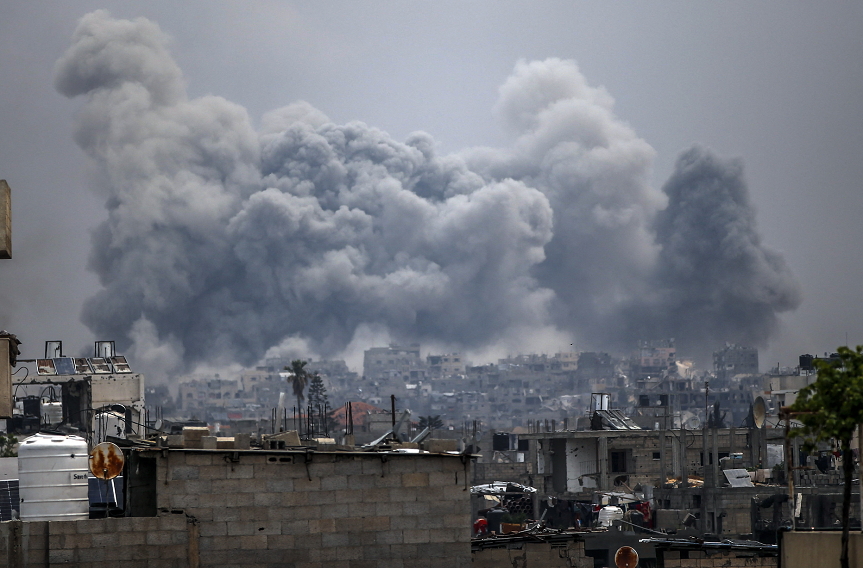
On May 15, 2025, in Gaza City, the Israeli army launched an air strike, sending thick smoke billowing into the air.
Fourth, bloc-based confrontation in the region has intensified, while the accelerated realignment of blocs has given rise to fluid regional alliances. Bloc-based rivalries have eased to varying degrees—between the conservative Islamic bloc of Turkey and Qatar and the Arab secular bloc led by Egypt, the UAE and Saudi Arabia, as well as between the Axis of Resistance and the moderate Arab bloc—with a concomitant cooling of proxy conflicts. In the meantime, however, bloc confrontation between the Axis of Resistance and the US-Israel bloc has continued to escalate, emerging as the primary source of regional turbulence. The restoration of diplomatic ties between Iran and Saudi Arabia, the UAE and Bahrain, the reconciliation between Qatar and Saudi Arabia, the UAE and Bahrain, the shift from confrontation to pragmatic cooperation between Turkey and Egypt, the UAE and Saudi Arabia, and the historic establishment of diplomatic relations between Israel and four Arab states—the UAE, Morocco, Sudan and Bahrain—have triggered a drastic shift in friend-foe alignments and frequent reshuffles of regional coalitions.
Fifth, the interplay between regional developments and shifts in the global landscape has strengthened. Turmoil and transformation define the profound changes unseen in a century, and the upheavals in the Middle East constitute a vital part of this paradigm shift. Major-power strategic competition, the Ukraine crisis, energy transition and climate change, scientific and technological innovation, and the reshaping of global supply and industrial chains have all transmitted rapid impacts to the Middle East. The United States has pursued "America First" in its foreign relations, stoked major-power strategic competition to heighten global tensions, and applied double standards in the Israel-Palestine conflict and the Ukraine crisis, thus undermining the so-called "rules-based international order". Such practices have further motivated regional states to pursue strategic autonomy and adopt an independent and diversified diplomatic approach. Middle Eastern countries’ "Look East" policy and their active pursuit of membership in the Shanghai Cooperation Organization (SCO) and the BRICS cooperation mechanism embody their strategic awakening. This trend not only drives the collective rise of the Global South but also elevates Middle Eastern countries’ influence in international affairs.
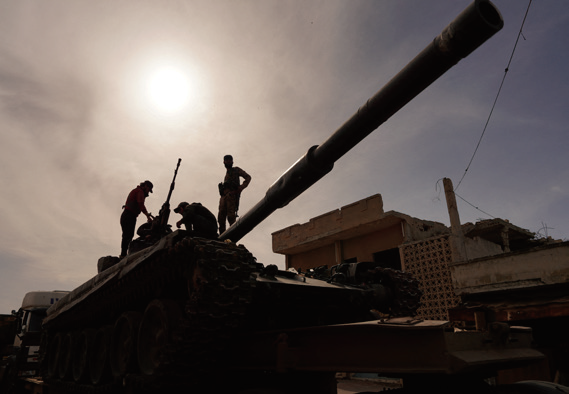
On March 17, 2025, in Qusair, Syria, soldiers were heading towards the border between Syria and Lebanon.
Major Factors Shaping the Restructuring of the Middle East Landscape
The formation and evolution of the Middle East landscape are driven by a confluence of internal and external factors, among which shifts in the balance of power and policy adjustments among major regional and extra-regional countries play a decisive role. The ongoing restructuring of the Middle East order is primarily propelled by three sets of factors.
First, the long-wave impact of the upheavals that have swept the Middle East over the past decade and more. This round of regional turbulence originated with the Arab Spring, whose political and social aftershocks have continued to reverberate. Syria, Yemen and Libya, mired in civil wars, have yet to achieve peace, and the power vacuums left in some countries remain unfilled, providing fertile ground for the rise of domestic extremist forces and foreign interference. Meanwhile, the governance crises within Arab states triggered by the Arab Spring have prompted Egypt, Tunisia, Algeria, Saudi Arabia, the UAE, Oman and other countries to embark on reforms, fostering the emergence of a development-oriented Middle East bloc.
Second, the outbreak of the new Israel-Palestine conflict and the spread of its spillover effects. In recent years, right-wing political forces in Israel have grown increasingly ascendant, the Palestinian cause has been marginalized, and the prospect of Palestinian statehood has dimmed. Against this backdrop, Hamas launched the military operation codenamed Al-Aqsa Flood against Israel in October 2023. Israel’s subsequent large-scale military campaign in the Gaza Strip has not only wrought a grave humanitarian disaster but also sparked multi-front clashes between Israel and Iran, Hezbollah in Lebanon, the Houthi movement in Yemen, and pro-Iranian Shia militias in Iraq and Syria. The new round of Israel-Palestine hostilities has not only compounded the difficulties of resolving the Palestinian issue but also dealt a heavy blow to regional stability, triggering a cascade of knock-on effects: intensified bloc confrontation, a slowdown of the Abraham Accords, a weakened Axis of Resistance, a redrawn political map of Lebanon and Syria, and disruption of the U.S. and Russian strategic deployments in the Middle East.
Third, policy shifts by major powers inside and outside the region have advanced the restructuring of the regional landscape and realigned geopolitical ties. "Intensified global major-power strategic competition has driven the evolution of the security, political, energy and development landscapes in the Middle East." U.S. policy adjustments constitute a pivotal force steering the Middle East’s restructuring. From Obama to Trump and then Biden, three successive U.S. administrations have prioritized major-power strategic competition and implemented a strategic retrenchment from the Middle East to enable a pivot to the Asia-Pacific. For all that, the U.S. has pursued a "withdrawal without disengagement" approach: while carrying out nominal troop drawdowns, it has stepped up meddling in the Middle East by backing Israel, arming Kurdish groups, and conducting airstrikes in Yemen, among other moves, fueling turbulence, imbalance and disorder across the region. Trump’s visit to three Gulf states—Saudi Arabia, Qatar and the UAE—in May 2025 underscored the transactional nature of his Middle East policy, while also confirming that the Gulf has become the centerpiece of U.S. major-power strategic competition in the Middle East. Russia’s Middle East policy has transitioned from proactive re-engagement to strategic defense. Having returned to the Middle East via military intervention in Syria in 2015, Russia significantly scaled back its commitment to the region following the outbreak of the Ukraine crisis in 2022. China, for its part, brokered the historic Saudi-Iranian rapprochement, which has greatly de-escalated regional security tensions, reshaped the Middle East security architecture, and laid a solid foundation for building a new regional security order.
As the U.S., Europe and Russia have focused on the Ukraine battlefield and the Asia-Pacific, with limited bandwidth for the Middle East, regional states have seized this strategic window to set their own political and economic agendas, playing a more prominent role in reshaping the Middle East order. Israel’s political shift to the right has seen it seek to "fundamentally alter the Middle East balance of power, weaken the Iranian axis, and enable Israel, the United States and its allies to build a new regional order with global reach", while pursuing the annexation of Palestinian territories. Turkey views the shifting global landscape and frequent geopolitical conflicts as a golden strategic opportunity. With the goal of building a "New Turkey", guided by neo-Ottomanism, pan-Turkism and Islamism, and employing military intervention, defense cooperation, humanitarian aid and crisis mediation as core tools, it aspires to establish regional leadership across West Asia and North Africa, Central Asia and the Caucasus, and the Balkans and Eastern Europe. The UAE has moved beyond its traditional business-centric statehood to pursue the status of a political power, intervening frequently in political and security affairs across West Asia and Africa. Saudi Arabia has launched an all-round strategic transformation covering domestic governance and foreign policy; its bold economic overhaul and assertive diplomatic outreach have consolidated its leading position in the Middle East. Faced with domestic and external pressures, Iran has recalibrated its strategy: domestically, it has prioritized stability and the development of a "resistance economy"; regionally, it has simultaneously advanced the Axis of Resistance and reconciled with Saudi Arabia and other Arab states; internationally, it has pivoted eastward by joining the SCO and BRICS cooperation mechanisms and deepening strategic coordination with China and Russia.
Beyond these three direct drivers, the evolution of the current Middle East landscape is underpinned by deeper structural causes. A web of inherent contradictions in the region sustains the continuous reshaping of its order.
1.Major-Power Intervention vs. Regional Autonomy. This contradiction has long defined the Middle East. Extra-regional powers have traditionally dominated regional affairs, with most regional states aligning themselves with outside powers and relying on external security protection. Countries pursuing strategic autonomy—such as Iran, Iraq, Libya and Syria—have often faced violent repression, diplomatic isolation and economic sanctions. Even Turkey, a NATO member, has been sanctioned by the West for advancing and safeguarding its own national interests. A fundamental pattern has thus emerged: weak external intervention correlates with strong regional autonomy, and strong external intervention correlates with weak regional autonomy. The marked decline in extra-regional intervention today has opened space for regional states to deepen their strategic autonomy.
2.Security Primacy vs. Development Priority. Middle Eastern countries face a profound dilemma between security and development. For decades, trapped in conflict and turmoil and confronted with the acute threat of foreign interference, most regional states have placed national security and political stability above economic development, with protracted conflicts devouring massive development resources. The rapid advance of economic globalization since the turn of the 21st century, the sustained rise of Asia, and especially the shock of the Arab Spring, have compelled regional states to recognize that political stability cannot endure without development, nor can Middle East security be achieved without regional development. In recent years, a growing number of countries from North Africa to the Gulf have made development their top priority, actively pursuing economic reform, transformation and upgrading to pursue long-term stability and enduring security. "The fundamental reason behind the restoration of Saudi-Iranian diplomatic relations and other reconciliation breakthroughs in the Middle East is that the pursuit of peace and development has become the consensus of most countries in the region. Countries’ yearning for development has made fostering a peaceful and stable environment an urgent regional imperative, and their diplomatic strategic autonomy is growing steadily." De-ideologization and pragmatic, national-interest-first strategies have become the deliberate choice of an expanding number of regional states. For Palestine, Israel, Lebanon, Syria, Yemen and Iran, however, security still outweighs development. Hobbesian fear has locked these states in an intractable security dilemma, with Israel and Iran as prime examples. Moreover, development-focused countries remain exposed to security vulnerabilities. Major regional security threats—the Palestinian issue, the Iranian nuclear question, longstanding ethnic and religious sectarian rifts, and geopolitical conflicts—persist and constrain economic development and reform.
3.Traditional Animosities vs. Emerging Challenges. The Middle East is rife with traditional conflicts: territorial and border disputes, ethnic tensions, religious and sectarian strife, and ideological divisions. These have spawned intractable issues including the Israel-Palestine conflict, the Kurdish question, and the Sunni-Shia rift, with profound repercussions for regional stability and international relations. Today, old and new contradictions are intertwined in the Middle East: unresolved longstanding disputes have been compounded by a host of new challenges, exacerbating regional turbulence and complicating conflict resolution. The outbreak of the latest Israel-Palestine conflict was no accident; it is closely linked to Washington’s unwavering pro-Israel bias, the marginalization of the Palestinian cause, the push for the Abraham Accords, and the building of an anti-Iranian regional coalition.
4.Spillover from Global Upheaval vs. Regional Internal Vulnerability. The Middle East’s vulnerability stems from a confluence of factors: a geo strategically pivotal location, rich energy endowments, heavy external dependence, weak state capacity, pervasive internal rifts, deficient governance, and frequent foreign interference. These traits render the region highly susceptible to external shocks and deeply reliant on the outside world. Globalization and major-power competition have further amplified this vulnerability. The outbreak of the Arab Spring was directly tied to Western-instigated color revolutions and surging global food prices. Current shifts in the Middle East are closely intertwined with the restructuring of the international order, major-power rivalry, the global energy transition and climate change. The march toward multipolarity in the Middle East reflects both a recalibration of the region’s internal power structure and regional adaptation to a changing global order.
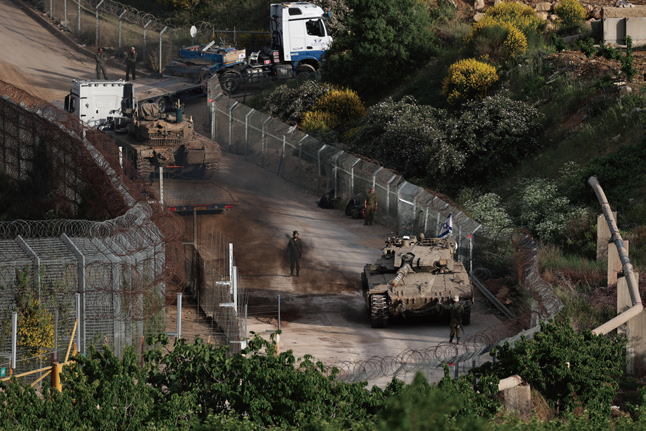
On March 17, 2025, in Qusair, Syria, soldiers were heading towards the border between Syria and Lebanon.
Multiple Impacts of the Evolving Middle East Landscape
The ongoing evolution of the Middle East landscape is essentially a contest of power redistribution between extra-regional major powers and key regional states. As such, the shifts and restructuring of the Middle East order inevitably generate a series of significant repercussions both within and beyond the region. Internally, these impacts manifest themselves in three principal dimensions.
First, the détente in inter-state relations creates favorable conditions for building a new Middle East security architecture, yet multiple complexities in the transition to a new order undermine the stability of the regional system. On the one hand, the sustained regional reconciliation wave helps defuse conflicts and confrontations, lower the risk of large-scale war, and advance the establishment of a new regional security framework. On the other hand, the transitional nature of the emerging order weighs negatively on regional stability. Uncertainties surrounding the Middle East policy of Trump 2.0, the acute and complex rifts between the U.S.-Israel bloc and the Iran-led Axis of Resistance, intractable regional flashpoints including the Israel-Palestine conflict and the Kurdish question, the uncertain future trajectory of Syria, and the persistent threat of extremism and terrorism all leave the regional security landscape fragile, with a lingering risk of major new conflicts and black-swan events across the region.
Second, the restructuring of the regional landscape exerts complex and profound effects on regional development and transformation. While regional economic reform has accelerated, political and social transitions face steep hurdles, and regional divergence has deepened markedly. Gulf states led by Saudi Arabia and the UAE are accelerating economic diversification to reduce oil dependence, prioritizing the development of artificial intelligence, manufacturing, mining, new energy, the digital economy, tourism, entertainment and other sectors to spearhead regional growth. Even as the Gulf has emerged as the engine of Middle Eastern development, its strong siphon effect has drawn massive inflows of capital and talent from inside and outside the region, widening the Middle East’s development divide and making it harder for non-Gulf states to escape the development lowland. Meanwhile, despite raging regional conflicts, Middle Eastern integration has registered modest progress, with stepped-up regional cooperation among the GCC, East Mediterranean states, Red Sea littoral countries, Israel and its Arab diplomatic partners, and Turkey and the Gulf states—opening opportunities for the long-sluggish regional economic integration. In the aftermath of the Syrian upheaval, energy and transport corridors linking the Gulf to the Mediterranean are expected to open up. The Israel-Saudi normalization process and the India-Middle East-Europe Economic Corridor, both stalled by the latest Israel-Palestine conflict, could be relaunched under Trump 2.0. Although Middle Eastern economies have made headway in reform, transformation and upgrading, they remain under immense pressure to pursue political and social change. Accelerating globalization, digitalization and urbanization have also brought into sharp relief rentier economies, high youth unemployment, population expansion, social inequality and inflation, creating a stark mismatch between daunting national development tasks and deficient state governance capacity.
Third, the strategic autonomy of regional states has spurred the exploration of new development paths. In recent years, regional powers such as Turkey, Saudi Arabia and the UAE have increasingly emphasized national identity reconstruction, with Gulf states, Egypt, Morocco, Algeria and Turkey all ramping up economic reform and developmental transformation. In safeguarding political stability, advancing economic transition, countering security threats and hedging against major-power rivalry, Middle Eastern states have shifted from passivity to proactivity, from alignment to autonomy, and from supporting roles to central protagonists in resolving regional issues and shaping a new regional order. The pursuit of greater strategic autonomy represents a conscious correction to the region’s long-standing voluntary or involuntary integration into the Western neoliberal order. It also helps redress the longstanding unequal and unbalanced relationship between regional states and Western powers, better protects regional countries’ security and development interests, and advances the vision of a "New Middle East". Saudi Arabia, Turkey, Qatar, Oman, the UAE and other regional states have actively assumed the role of international mediators to ease major-power tensions and regional conflicts, pushing for dialogue between Russia and Ukraine, the U.S. and Iran, the U.S. and the Houthis, Israel and Hamas, among other parties, and playing a constructive role in regional peace and stability.
Externally, the shifts in the Middle East landscape exert multi-faceted impacts, most notably on geopolitics and the international order, global security, and the restructuring of global industrial and supply chains.First, the evolving Middle East landscape has raised the region’s international strategic standing. After nearly two decades of relative quiescence in the 21st century, the Middle East has re-emerged as a key arena for major-power rivalry, ranking second only to Eastern Europe and the Asia-Pacific in strategic salience amid major-power competition. Major powers today have a stronger incentive to seek cooperation with Middle Eastern states, while their ability and willingness to dictate regional political and security affairs have diminished. This has effectively reduced the dominant role of extra-regional powers in the Middle East and eased the region’s exposure to external intervention. With less pressure to take sides in major-power competition, regional states can pursue diversified and balanced diplomacy, leveraging emerging major powers to balance traditional hegemonic powers—protecting their vested interests while maximizing national gains. The accession of Middle Eastern states including Egypt, the UAE, Saudi Arabia and Iran to the Shanghai Cooperation Organization (SCO) or BRICS cooperation mechanisms has elevated their international standing and voice in global governance, advanced the rise of the Global South, propelled the international order toward multipolarity, and contributed to the transformation of the global order and improvement of the global governance system.Second, the changing Middle East landscape challenges global security across multiple fronts: the restructuring of the international security architecture, the proliferation of weapons of mass destruction, extremism and terrorism, and global migration and refugee flows. The Israel-Palestine conflict and the Ukraine crisis stand as the two primary flashpoints in contemporary global security. The Iranian nuclear issue remains a critical international security matter centered on nuclear non-proliferation, and global attention to it will intensify with Trump’s return to office. At the same time, U.S. support for Israel and the joint U.S.-Israeli crackdown on the Palestinians, as well as the new upheaval in Syria, have provided a strong impetus for the global spread of extremism and terrorism.Third, the shifting Middle East landscape is reshaping global value chains. This is reflected primarily in the Middle East’s elevated position in the international energy landscape amid factors including the Ukraine crisis, the region’s role as a strategic hub driving competition over international economic corridors, and its growing stature in the restructuring of global industrial chains.
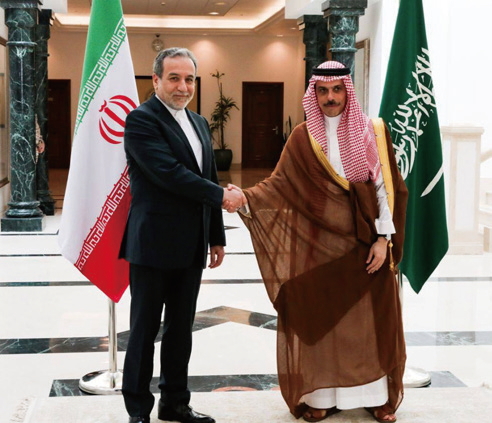
On May 10, 2025, in Jeddah, Saudi Arabia, Saudi Foreign Minister Faisal met with Iranian Foreign Minister Alaghi.
Conclusion
The current round of shifts in the Middle East landscape is defined by continuity, abruptness, dynamism, transitionalness and endogeneity. The new regional configuration suffers from weak stability, representing a fragile equilibrium forged by competing forces in the short term. By its very nature, this configuration remains a transitional phase between the old Middle East order and an emerging new one. The present Middle East landscape contains numerous positive factors conducive to building a new regional order: amid majorpower strategic competition, extraregional powers have grown more reliant on the Middle East yet less intent on controlling it; regional states have achieved greater strategic autonomy; ideological polarization has faded; and development imperatives have increasingly taken precedence over security dominance. These positive shifts have injected new hope into regional peace and development, creating initial conditions for the Middle East to move from disorder to order. In the transformation of both the global and Middle Eastern systems, deWesternization, decentralization and diffusion of power have become increasingly salient trends, which may foster peaceful, stable and sustainable development in the Middle East in the years ahead. That said, regional multipolarity does not guarantee strategic stability; it may equally intensify acute confrontations.
Looking ahead, the establishment of a longstable order in the Middle East hinges on resolving deepseated contradictions: majorpower intervention versus regional autonomy, security versus development, rootcause issues versus modernization transition, and deep integration into globalization versus internal fragility. It will also depend on the gradual emergence of a more just and equitable new international political and economic order.
(Author: Tang Zhichao,Professor, School of International Politics and Economics, University of CASS; Director and Research Fellow, Middle East Development and Governance Research Center, Institute of West-Asian and African Studies, CASS)
 国际合作中心版权所有 © 京ICP备2022021348号-2
©2006 - 2026 Copyright International Cooperation Center
网站版权登记号:国作登字-2022-F-10176092
E-mail:info@icc.org.cn