
Prospects for the Global Political and Economic Impacts of a U.S.-Israeli Attack on Iran
In February 2026, the United States and Iran held three rounds of negotiations over the Iranian nuclear issue but remained deadlocked on core topics such as uranium enrichment. On February 28, the U.S. and Israel launched a joint military strike against Iran. Iran swiftly retaliated and announced the closure of the Strait of Hormuz the same day. On March 1, Iranian media confirmed the death of Iran’s Supreme Leader Ali Khamenei, and Iranian officials publicly stated that Iran’s retaliation would be “without any red lines.” On March 2, Trump indicated that operations against Iran could last four to five weeks, ruling out nothing, including the deployment of U.S. ground troops. In response, Iran issued a tough rejoinder, stating it was prepared for a protracted war and would not resume negotiations with the U.S. On March 4, U.S. Secretary of Defense Hegseth stated that the Iran crisis could persist for weeks, potentially as long as eight weeks or more.
As a global energy hub and geopolitical flashpoint, the Middle East’s dramatic instability has powerful global spillover effects. In the short term, it will directly roil global energy and financial markets, with far-reaching consequences for global economic recovery and the international governance system.
1.Strategic Intent of the U.S.-Israeli Military Strike
The immediate trigger for the joint strike was the collapse of nuclear negotiations, with both countries concluding that diplomacy could no longer curb Iran’s nuclear program. Trump claimed that without U.S. military action, Iran would acquire nuclear weapons “within two weeks”—a narrative to justify the strike. Beneath this pretext lie three core U.S. strategic objectives:
Reshaping U.S. Regional Dominance in the Middle East. For decades, Iran has built the Axis of Resistance—an anti-U.S. regional network spanning Lebanon, Syria, Iraq, and Yemen—through ideological outreach and military aid. This network has persistently challenged U.S. military presence in the Middle East, becoming a major obstacle to U.S. hegemony. U.S. strategic assessments conclude that Iran’s power has been severely weakened in recent years; the strike aims to further erode its regional influence and dismantle its proxy networks.
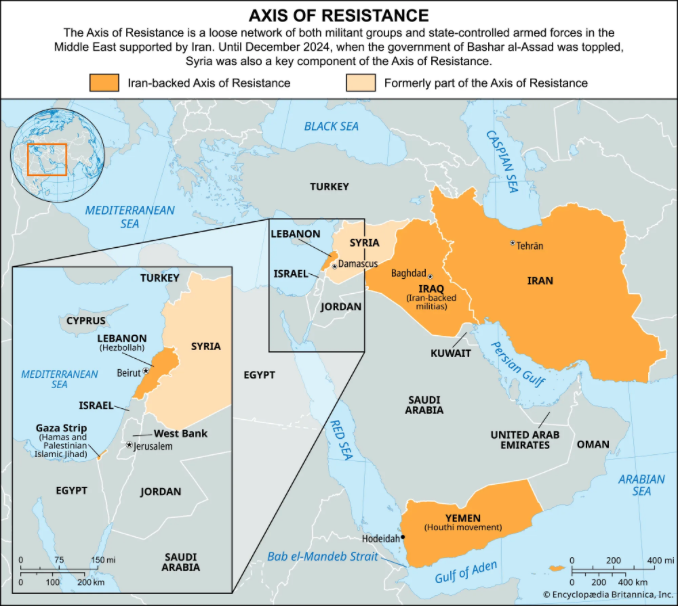
The Axis of Resistance is an Iran-led informal military-political network centered on anti-U.S. and anti-Israeli objectives. Comprising multiple state and non-state armed groups, it stretches geographically from Lebanon on the eastern Mediterranean to Yemen on the Red Sea—hence its name.
Controlling the Global Energy Chokepoint and Defending Petrodollar Hegemony. Iran holds the world’s third-largest oil reserves and second-largest natural gas reserves, while controlling the Strait of Hormuz—a critical artery for energy shipping. The strait handles ~25% of global oil trade and ~20% of liquefied natural gas (LNG) trade. In recent years, Iran has steadily promoted de-dollarization in energy trade, expanding local-currency settlements with multiple nations—a direct challenge to the petrodollar system. The U.S. seeks to topple Iran’s regime, tighten control over energy lifelines, and safeguard the petrodollar.
Securing Political Advantage for the Midterm Elections. The U.S. will hold congressional midterm elections in Q4 2026, which will determine control of the House and Senate. Facing weak domestic approval and pressure over livelihood issues, the incumbent administration views foreign military action as a classic tool to divert public attention, project tough diplomacy, and boost voter support. The Trump administration aims to deliver a landmark foreign-policy victory via a swift, precise strike to gain an edge in the midterms.
For Israel, eliminating Iran’s long-term existential threat is the core motive. Since Iran’s Islamic Revolution, Iran has rejected Israel’s right to exist and imposed multi-front military pressure via proxy militias—with the nuclear issue crossing Israel’s red line for national security. The joint strike is an extreme move by Israel, driven by chronic security anxiety, to neutralize Iran’s nuclear and long-range strike capabilities and entrench its status as the Middle East’s dominant military power.
2. Short-Term Global Economic Shocks from Escalating Conflict
Surging Global Energy Prices. Iran’s closure of the Strait of Hormuz directly severs a critical global energy supply artery, sharply raising shipping costs and threatening near-term spikes in oil and gas prices. On March 2, QatarEnergy—the world’s largest LNG producer—suspended operations after its facilities were attacked, exacerbating supply shortages. The same day, European benchmark natural gas prices surged over 50%, and Brent crude opened 13% higher.
Heightened Volatility in Currency and Financial Markets. Escalating conflict stokes fear and risk aversion, triggering sharp short-term swings in global financial markets and a broad correction in major equity indices. As the world’s primary safe-haven currency, the U.S. dollar may strengthen temporarily, though this is unlikely to reverse its long-term structural decline. Most emerging-market currencies will depreciate in the near term, with foreign-exchange volatility spiking.
Lingering Inflation Risks and Disrupted Monetary Policy Adjustments. As a fundamental input for industry and households, energy price hikes trigger full-chain inflation transmission. The severity depends on the conflict’s duration: a resolution within four weeks would contain global inflation, but a 1–3 month (or longer) conflict could spark a renewed inflation surge, even stagflation risks in some economies. Major central banks, having hiked rates aggressively to curb inflation, are now poised to cut rates. The strike risks reviving imported inflation, delaying rate cuts across economies, and deepening global growth headwinds.
Divergent Impacts Across Economies. China: Boasts strong economic resilience and ample strategic oil reserves to mitigate short-term energy volatility. However, prolonged Middle East instability could strain supplies: ~13.4% of China’s seaborne crude imports come from Iran, and 40% of its energy supplies transit the Strait of Hormuz. Higher shipping costs may ripple through domestic industrial and supply chains.
United States: Higher oil prices will boost domestic energy firms but risk reviving inflation. Elevated living costs will disproportionately hurt low- and middle-income households, with prolonged confrontation potentially harming the administration’s midterm election prospects.
Energy Exporters: Stand to gain from near-term price spikes but face long-term risks from regional instability.
Energy Importers: Will see worsening trade balances and rising imported inflation.
Emerging Markets: Face a perfect storm of currency depreciation, capital outflows, and mounting debt stress from dollar strength and market turbulence.
3. Medium- to Long-Term Risks of Spillover and Governance Challenges
Long-Term Risk of Middle East Geopolitical Restructuring and Full-Scale Conflict. A devastating U.S.-Israeli strike on Iran’s military and nuclear infrastructure would cripple Iran’s regional influence and heighten uncertainty over the Middle East order. Meanwhile, Iran’s retaliation is already underway, expanding the conflict beyond bilateral confrontation. Prolonged escalation raises the risk of regional chaos, further destabilizing the Middle East and the world.
U.S. Hegemony and Deepening Global Governance Disorder. The joint strike epitomizes the U.S. hegemonic playbook, following its targeting of Venezuelan President Maduro—upholding an “America First” agenda of meddling in foreign affairs, entrenching regional dominance, and prioritizing self-interest. Launched without UN Security Council authorization, the strike flagrantly violates the UN Charter and international law, constituting a severe breach of national sovereignty and territorial integrity. By bypassing the UN to resolve disputes unilaterally through force, the U.S. accelerates global governance breakdown and undermines UN authority.
Accelerating Weaponization of Technology and Urgent Global Security Governance. The strike highlights the weaponization of cutting-edge technology: the U.S. deployed AI-aided intelligence analysis and target recognition, dramatically accelerating the war. This sets a dangerous precedent, spurring global investment in military technology and speeding the weaponization of technology worldwide. While advanced military technologies create new governance challenges, geopolitical tensions and tech competition have stalled global security cooperation. Establishing unified tech control and ethical norms has become an urgent global imperative.
Amid the spiraling Middle East crisis, China stands firmly on the side of peace and justice, upholding international law and fairness. It strongly condemns the U.S.-Israeli strike on Iran, calls for an immediate ceasefire, and urges all parties to exercise maximum restraint to avoid further escalation. China will continue playing a constructive role in advancing Middle East peace.(Author: Duan Cunru, Associate Research Fellow, World Development Institute, Development Research Center of the State Council)
 国际合作中心版权所有 © 京ICP备2022021348号-2
©2006 - 2026 Copyright International Cooperation Center
网站版权登记号:国作登字-2022-F-10176092
E-mail:info@icc.org.cn